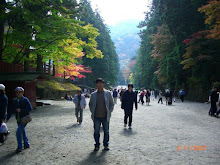
One of human greatest achievements ever made! It seems that riding the train itself is a great pleasure given the stunning scenery across diverse landscape from Shanghai to the top of the world. Men could make anything possible; it is just the matter of time.
Thursday, June 12, 2008
Tibet Railway (Part 1)


Inflation in emerging economies: An old enemy rears its head
 Emerging economies risk repeating the same mistakes the developed world made in the inflationary 1970s
There are an alarming number of similarities between developing economies today and developed economies in the early 1970s.
Inflation in developing countries are in deed more serious, as official figures often understate their inflationary pressure. Widespread government subsidies and price controls are one reason, and price indices are often skewed by a lack of data or government cheating.
The recent jump has been caused mainly by surging oil and food prices and speculation.
Governments have responded with more price controls and export bans. In the short run such measures may help to cap inflation and avoid social unrest, but in the long run they do more harm than good.
Some central banks have nudged up interest rates this year, but they have not kept pace with inflation, so real rates have fallen and are now negative in most countries. Many policymakers in emerging economies argue that serious monetary tightening is not warranted: higher inflation is due solely to spikes in food and energy prices, caused by temporary supply shocks and speculation.
The synchronised jump in global food prices suggests there is more to the story than disruptions to supply. Prices are also rising partly because loose monetary conditions in emerging economies have boosted domestic demand.
Another reason why central banks cannot ignore agflation is that it can quickly spill over into other prices. Food accounts for 30-40% of the consumer-price index in most emerging economies, compared with only 15% in the G7 economies.
Philip Poole, also of HSBC, says that many emerging economies have run out of spare capacity because investment has not kept pace with economic growth. Hence firms are more likely to pass on cost increases.
In another echo, those central banks often face intense political pressure to hold rates low to boost growth and jobs. To many Western economists and policymakers the solution is simple: emerging economies should allow more flexibility in their exchange rates. This would permit them to raise interest rates, and a stronger currency would help to curb import prices. Another solution is to tighten fiscal policy to reduce excess demand.
China has helped to hold down inflation in developed economies because its goods are much cheaper, replacing more costly goods. Competition from China also forces local producers to cut their prices and it curbs wage demands in rich countries. As China moves up the value chain it will pull down the prices of a wider range of products. China will continue to help hold down global prices—although possibly by less than in the past.
Monday, June 09, 2008
Short Classic Jokes
- The patient says, "Give me the bad news first!"Doctor replies, "You've got AIDS.""Oh, no! What could be worse than that?" asks the patient."You've also got Alzheimer's Disease."Looking relieved the patient says, "Oh...Well, that's not so bad. At least I don't have AIDS."
- The teacher of the Earth Science class was lecturing on map reading. He spent the class explaining about latitude, longitude, degrees, and minutes. Towards the end of class, the teacher asked his students, "Suppose I asked you to meet me for lunch at 23 degrees, 4 minutes north latitude and 45 degrees, 15 minutes east longitude..." A student's voice broke the confused silence, and volunteered, "I guess you'd be eating alone, sir."
- A man is walking down the street and he sees a boy riding a wagon. The boy has his dog pulling it with a rope attached to the dogs balls. The man says "You know if you tied it around his neck, it would go faster." The boy replies, "I know but then I wouldn't get the cool siren."
- A young couple gets married, and the groom asks his bride if he can have a dresser drawer of his own that she will never open. The bride agrees. After 30 years of marriage, she notices that his drawer has been left open. She peeks inside and sees 3 golf balls and $1,000.She confronts her husband and asks for an explanation. He explains "Every time I was unfaithful to you, I put a golf ball in the drawer." She figures 3 times in 30 years isn't bad and asks "But what about the $1,000?" He replied "Whenever I got a dozen golf balls, I sold them."
- One day a girl brings home her boyfriend and tells her father she wants to marry him. After talking to him for while, he tells his daughter she can't do it because he's her half brother. The same problem happens again four more times! The girl starts to get pissed off. She goes to her mom and says, "Mom... What have you been doing all your life? Dad's been going around laying every maiden in the town and now I can't marry any of the five guys I like because they have turned out to be my half brothers!!!"
Her mom replies, "Don't worry darling, you can marry any one of them you want, he isn't really your dad."
Friday, June 06, 2008
Useful dos and don’ts for fast economic growth
 Growth is not everything, but it is the foundation for everything. The poorer the country the more important growth becomes, partly because it is impossible to redistribute nothing and partly because higher incomes make a huge difference to the welfare of the poorest.
Based on an analysis of 13 countries that have managed growth of 7 per cent a year over at least 25 years in the recently published Growth Report, countries enjoy high growth share five points of resemblance: they fully exploited the opportunities afforded by the world economy; they maintained macroeconomic stability; they sustained high rates of saving and investment; they let markets allocate resources; and they had committed, credible and capable governments.
These points are consistent with the so-called “Washington consensus” of the 1990s, which emphasised macroeconomic stability, trade and the market. Yet the report’s emphasis is different: it does not stress privatisation, free markets and free trade, while it does emphasise the role of the so-called “developmental state”.
The ingredients of fast growth include: investment of at least 25 per cent of gross domestic product, predominantly financed by domestic savings, including investment of some 5-7 per cent of GDP in infrastructure; and spending by private and public sectors of another 7-8 per cent of GDP on education, training and health. They also include: inward technology transfer, facilitated by exploitation of opportunities for trade and inward foreign direct investment; acceptance of competition, structural change and urbanisation; competitive labour markets, at least at the margin; the need to bring environmental protection into development from the beginning; and equality of opportunity, particularly for women.
Particularly welcome is the short list of policies to be avoided. Among them are: subsidising energy; using the civil service as employer of last resort; reducing fiscal deficits by cutting spending on infrastructure; providing open-ended protection to specific sectors; using price controls as a way to curb inflation; banning exports, to keep domestic prices low; underinvesting in urban infrastructure; underpaying public servants, such as teachers; and allowing the exchange rate to appreciate too far, too quickly.
Running through the report is belief in the role of an engaged government. This reflects the commission’s composition and intended audience. The obvious weakness is that it ignores how effective governments emerge. But the stress is correct: rapid development occurs in strong states, with effective governments, not in weak ones.
Thursday, May 29, 2008
Sparking Creativity in the Workplace
Can every employee be creative?
The paper shatters the myths surrounding creativity; for example, that it depends on personality, intelligence, character, age or experience, or that it belongs to people who live dangerously. The truth is that very often, the best ideas come from conservative people. Studies have shown that unusually intelligent people with a high IQ are no more creative than those with an average IQ.
How, then, can companies foster creative talent?
Creativity results from having the right aptitudes and attitudes: the ability and the will. Employees need freedom to work, since the best ideas often come when people are having fun, laughing and enjoying their work. Here are ideas for sparking creativity in ourselves and in our subordinates.
Improving Our Own Creative Talent
A creative attitude is a permanent willingness to approach problems and situations in new ways. It is based on three basic attitudes: tenacity, confidence and enthusiasm. Besides the attitude or will, we also need the aptitude or ability. In business, originality is not enough. Ideas must be useful and practical. To enhance our ability to produce new ideas we should learn to make better use of the "old elements."
Fostering Subordinates' Creative Talent
A creative attitude is an inner willingness, and so, will depend essentially on our subordinates' motivation. The first measure is to reward initiative and encourage experimentation. Second, align the right person with the right task.
There are basically four ways to encourage subordinates' creative aptitude: foster diversity; invite subordinates to explore and use sources of innovation; ask them SCAMPER questions (substitute, combine, adapt, modify, put for other purposes, eliminate, rearrange or reverse); and encourage them to use team creativity techniques.
As employees search for innovation opportunities, they should draw on the seven sources of innovation identified by management leader Peter. F. Drucker: surprises, incongruities, bottlenecks, changes in the industry, changes in perception, demographic changes and changes in knowledge.
To promote lateral thinking, teams should turn to creativity techniques such as provocation, broken logic, brainstorming or the six thinking hats, in which each team member must look at a subject or situation from a different "color" or angle.
Thus, to establish a creative culture, companies should concentrate on inspiring people with clear missions and goals, and they should promote information exchange and collaboration.
Tuesday, May 20, 2008
Cambodia's coming energy bonanza
 If the United Nations, World Bank and Harvard University are to be believed, Cambodia is poised to become a major new global energy exporter, with a fossil-fuel windfall that promises to double the country's current GDP and potentially lift millions of Cambodians out of poverty.
The World Bank has said that Cambodia's total energy reserves may be as high as 2 billion barrels of oil and 10 trillion cubic feet of natural gas. Depending on future world prices, fuel exports could generate annual revenues upwards of US$2 billion, or several times the current combined amount that Cambodia generates in domestic revenues and receives in foreign aid. Meanwhile, Cambodian energy officials indicated this week that they hope to ramp up production as early as 2009, three to seven years earlier than the World Bank projected as feasible.
An energy-rich Cambodia would appreciably enhance the war-torn country's geostrategic significance, particularly as the United States and China aggressively joust for access to new fuel sources around the globe.
Yet there's also a potential Cold War twist to China's bid. Any future oil-and-gas-production agreements with the CPP-led government will likely need to pass through Sokimex, Cambodia's leading conglomerate, which through a joint venture with Tela Petroleum Group controls 80% of the country's domestic oil and gas distribution. Energy analysts note that Cambodia's newfound reserves coincide with the expectation that Vietnam's own diminishing fuel supplies will run out over the next decade. So far Hanoi has no plans on how it might fill this future energy gap.
What is more likely is that senior CPP officials have designs on building up Sokimex and perhaps also Tela Petroleum through lucrative state energy concessions, which, once converted into foreign-currency earnings, may be tapped to support its patronage-based political machine and further consolidate the party's dominance over Cambodian politics - akin to how Malaysia's ruling United Malays National Organization has relied on state oil giant Petronas for its own political purposes.
Western donors have already sounded warnings about the potential pitfalls of Cambodia's supposed newfound energy wealth. Hun Sen's government has come under intense donor pressure to tackle endemic corruption among his ranks.
Friday, May 02, 2008
10 Ways to Catch a Liar
By Heather Hatfield
Tip No. 1: Inconsistencies
"When you want to know if someone is lying, look for inconsistencies in what they are saying," says Newberry, who was a federal agent for 30 years and a police officer for five.
Tip No. 2: Ask the Unexpected
"Watch them carefully," says Newberry. "And then when they don't expect it, ask them one question that they are not prepared to answer to trip them up."
Tip No. 3: Gauge Against a Baseline
One of the most important indicators of dishonesty is changes in behavior. You want to pay attention to someone who is generally anxious, but now looks calm. Or, someone who is generally calm but now looks anxious.
Tip No. 4: Look for Insincere Emotions
"Most people can't fake smile," says O'Sullivan. "The timing will be wrong, it will be held too long, or it will be blended with other things. Maybe it will be a combination of an angry face with a smile; you can tell because their lips are smaller and less full than in a sincere smile."
Tip No. 5: Pay Attention to Gut Reactions
While an average person might not know what it is he's seeing when he thinks someone isn't being honest and attribute his suspicion to instinct, a scientist would be able to pinpoint it exactly.
Tip No. 6: Watch for Microexpressions
"A microexpression is a very brief expression, usually about a 25th of a second, that is always a concealed emotion," says Ekman, PhD, professor emeritus of psychology at the University of California Medical School in San Francisco.
Tip No. 7: Look for Contradictions
"The general rule is anything that a person does with their voice or their gesture that doesn't fit the words they are saying can indicate a lie," says Ekman.
Tip No. 8: A Sense of Unease
"When someone isn't making eye contact and that's against how they normally act, it can mean they're not being honest," says Jenn Berman, PhD, a psychologist in private practice.
Tip No. 9: Too Much Detail
Too much detail could mean they've put a lot of thought into how they're going to get out of a situation and they've crafted a complicated lie as a solution.
Tip No. 10: Don't Ignore the Truth
"It's more important to recognize when someone is telling the truth than telling a lie because people can look like they're lying but be telling truth," says Newberry http://www.webmd.com/balance/features/10-ways-catch-liar?page=3
Tip No. 1: Inconsistencies
"When you want to know if someone is lying, look for inconsistencies in what they are saying," says Newberry, who was a federal agent for 30 years and a police officer for five.
Tip No. 2: Ask the Unexpected
"Watch them carefully," says Newberry. "And then when they don't expect it, ask them one question that they are not prepared to answer to trip them up."
Tip No. 3: Gauge Against a Baseline
One of the most important indicators of dishonesty is changes in behavior. You want to pay attention to someone who is generally anxious, but now looks calm. Or, someone who is generally calm but now looks anxious.
Tip No. 4: Look for Insincere Emotions
"Most people can't fake smile," says O'Sullivan. "The timing will be wrong, it will be held too long, or it will be blended with other things. Maybe it will be a combination of an angry face with a smile; you can tell because their lips are smaller and less full than in a sincere smile."
Tip No. 5: Pay Attention to Gut Reactions
While an average person might not know what it is he's seeing when he thinks someone isn't being honest and attribute his suspicion to instinct, a scientist would be able to pinpoint it exactly.
Tip No. 6: Watch for Microexpressions
"A microexpression is a very brief expression, usually about a 25th of a second, that is always a concealed emotion," says Ekman, PhD, professor emeritus of psychology at the University of California Medical School in San Francisco.
Tip No. 7: Look for Contradictions
"The general rule is anything that a person does with their voice or their gesture that doesn't fit the words they are saying can indicate a lie," says Ekman.
Tip No. 8: A Sense of Unease
"When someone isn't making eye contact and that's against how they normally act, it can mean they're not being honest," says Jenn Berman, PhD, a psychologist in private practice.
Tip No. 9: Too Much Detail
Too much detail could mean they've put a lot of thought into how they're going to get out of a situation and they've crafted a complicated lie as a solution.
Tip No. 10: Don't Ignore the Truth
"It's more important to recognize when someone is telling the truth than telling a lie because people can look like they're lying but be telling truth," says Newberry http://www.webmd.com/balance/features/10-ways-catch-liar?page=3
Saturday, April 26, 2008
Ten Tips to Encourage Meaningful Conflict
Conflict avoidance is most frequently the topic when conflict in organizations is discussed. Conflict resolution - as quickly as possible - is the second most frequent topic. This is bad news because meaningful work conflict is a cornerstone in healthy, successful organizations. Conflict is necessary for effective problem solving and for effective interpersonal relationships. So, knowing how to raise issues and participate in meaningful work conflict is key to your success in work and in life. These tips will help.
- Create a work environment in which healthy conflict is encouraged by setting clear expectations.
- Reward, recognize, and thank people who are willing to take a stand and support their position.
- If you experience little dissention in your group, examine your own actions.
- Expect people to support their opinions and recommendations with data and facts.
- Create a group norm that conflict around ideas and direction is expected and that personal attacks are not tolerated.
- Provide employees with training in healthy conflict and problem solving skills.
- Look for signs that a conflict about a solution or direction is getting out of hand.
- Hire people who you believe will add value to your organization with their willingness to problem solve and debate.
- Make executive compensation dependent upon the success of the organization as a whole as well as the accomplishment of individual goals.
- If you are using all of the first nine tips, and healthy work conflict is not occurring ... You need to sit down with the people who report to you directly and with their direct reporting staff and ask them why. Some positive, problem solving discussion might allow your group to identify and rectify any problem that stands in the way of open, healthy, positive, constructive work conflict and debate.
Country for Sale
 Almost half of Cambodia has been sold to foreign speculators in the past 18 months - and hundreds of thousands who fled the Khmer Rouge are homeless once more.
Cambodia is a nation that would drown if their boat tipped over; it is also a country whose citizens mostly do not belong to the places where they have ended up. The Khmer Rouge saw to that, eviscerating the kingdom after coming to power. Below are some highlights extracted from the long article:
- Forty-five per cent of the country's entire landmass has been sold off - from the land ringing Angkor Wat to the colonial buildings of Phnom Penh to the south-western islands. By 2006, the World Bank estimated that 40,000 had been made homeless in Phnom Penh alone.
- Rumours were buzzing around Sihanoukville's covered market that virtually every island in the region was up for sale. Over the following months, Koh Russei and Koh Ta Kiev, Koh Bong and Koh Ouen, Koh Preus, Koh Krabei and Koh Tres were all snapped up by foreigners, who then started negotiating for mainland sites, too, among them public beaches with names such as Serendipity, Occheuteal and Otres.
- The troubled kingdom of Cambodia had suddenly found itself a refuge for cash and speculators fleeing paralysed western financial markets.
- Foreign fund managers had started pitching up in Phnom Penh, alerted by the country's unexpected boom in tourism. Their interest was land speculation: buying up large sites in developing countries that they would then sit on in the hope that, with the influx of tourists, land values would soar.
- Hun Sen and his ruling CPP have, in effect, put the country up for sale. Crucially, they permit investors to form 100% foreign-owned companies in Cambodia that can buy land and real estate outright - or at least on 99-year plus 99-year leases. No other country in the world countenances such a deal. Even in Thailand and Vietnam, where similar land speculation and profiteering are under way, foreigners can be only minority shareholders.
- Many foreign funds - hedge funds, property funds, private equity funds - operating on the outer margins of the financial world thrive on complexity, risk and maximising profit. In Phnom Penh, they found an ideal partner in the prime minister, who has created a unique business environment. Since the mid-90s, Hun Sen and the CPP have declined to enforce money-laundering legislation and have concerned themselves little with the probity of investors. Foreign businessmen were offered nine-year tax holidays, and were allowed to hold their cash in US dollars in banks outside the country.
- In July 2007, Hun Sen, gambling on his people's tenuous connection with the land, changed the designation of the southern islands so they could be sold. The forests, lakes, beaches and reefs - and the lives of the thousands of residents - were quietly transferred into the hands of private western developers.
- It was Hun Sen who, as early as 1989, realised the power of land. As he privatised the land, "he simultaneously cut off the rights of 360,000 exiled Cambodians, awarding prime slices to political allies and friends." Although he bathes his speeches in socialist values, even his closest aides told us that Hun Sen was more often than not a pragmatist.
- The investors could have sold up and come away rich. But this was development with a difference. They were speculating on the future value of the land, believing that by adding only modest infrastructure, perhaps attaching big-name hoteliers, they would reap vast profits in seven to 10 years.
- Since the land sell-offs, members of the government and its allies have been splashing huge sums around. A Korean developer told us that when he marketed Phnom Penh's first skyscraper, the 42-storey Gold Tower project in February, all two dozen £750,000 penthouse suites were bought within 24 hours by "an honour roll of the CPP and its friends in the military".
- Simon Taylor, the director of Global Witness, an international NGO that was forced to leave the country last year, having accused the CPP of running a logging racket, paints a depressing picture: "A shadow state has grown up, a government that misappropriates public assets, extorts from businesses and manages an extensive illicit economy.
- Has the legacy of the Khmer Rouge been purged? Naly Pilorge, director of Licadho, a local human rights NGO, thinks not: "Everyone claims Cambodia has come through the period of barbarism, but the sadism is still bubbling beneath the surface. Extreme violence, greed and disregard for the most basic human rights - of giving people a place to live - are still with us daily. The methods of the past are being used to dictate our future."
Thursday, April 24, 2008
Tales of the Mekong Cambodia 1/6
This is one of the best documentaries about Cambodia from NG. It shows how important Cambodia's Mekong and Great Lake are. Cambodia's mighty rivers and lakes are not only rich in bio-diversity, they make Cambodia a beautiful and great nation. Tonle Sap gives birth to the Khmer civilzation; the Mekong is the life blood of Tonle Sap. Both the Mekong and Tonle Sap are now facing ecological disasters due to climate change, overexploitation and poor governance.
Wednesday, April 23, 2008
Southeast Asia's 40 Richest
The present SE's richest person is a Malaysian, Robert Kuok. Top the 40 richest is Indonesia, while Malaysia has the most superwealthy, including six billionaires. Most of millionaires in SE are from Asean Five. The list includes head of states and family fortunes. It ranks mainly businessmen, as it is still hard to know exactly how much some government officials have. Take Suharto and Hun Sen as examples.
Wednesday, April 16, 2008
Asia Needs to Provide Global Leadership
Can Asians think?
The dean of Singapore's Lee Kuan Yew School of Public Policy says it's time to come to grips with the end of Western domination of global affairs. Below is his interview with BW:
You have boldly written about the hypocrisy of the West and its own inner conflicts that do not allow it to acknowledge that its time is up. What was the trigger that compelled you to express yourself thus?
I wrote because the Asian voice is never heard in the rest of the world. We are entering a completely new historical era, with new maps and new guidelines, [moving from] a monocultural world to a multicultural world. This new era is so different because it is the end of the era of Western domination of world history—though not the end of the West—and the beginning of a new era of a rising Asia. Because of Western dominance, the West has run the world for the past 200 years—in many ways benignly. It could do that when it felt confident and secure, when it felt the future belonged to it. But history teaches us that when these same powers become insecure, they become part of the problem, not part of the solution.
What are some of the consequences?
There is a global leadership vacuum at a time when you need new kinds of thinking. Asia needs to provide global leadership. But none of us seems to want to figure out what the consequences of the end of Western domination will be. It is painful for the West to give up power [and] it resists the transfer of power. It is anachronistic and absurd that the head of the IMF should still be a European and the head of the World Bank should still be American. The Doha round failed because the West has lost the confidence that it can push for trade talks and win.
And you think Asia would do better?
Asians could do as good a job in representing global interests. It is the responsibility of the rising powers to take this on, but there is a reluctance on the part of India and China to take this on too early.
But hasn't Asia been a big beneficiary of this Western dominance?
Yes. East Asia rose because [of] the rules-based order of the world, inherited from the West. America has done more for the rise of Asia than any other country. The yeast from which Asia rose came from Asian elites trained in the U.S. Larry Summers, then-president of Harvard University, said that in the industrial world, productivity improved by 50% in a single generation; in Asia, it has improved by 10,000%.
You give high praise to the Association of Southeast Asian Nations (Asean) over the EU. Why?
Asean is an economic mini-power worth under $1 trillion, but it is a diplomatic superpower. The EU is an economic superpower, but a diplomatic mini-power. After all these years, the EU still remains a Christian club. Look at Asean. It has all religions in it: Buddhism, Hinduism, Islam, Taoism, Confucianism, Communism, Christianity. Asean is the role model of the future, the EU is not.
What about the Middle East. Where does its rise fit in?
Its moment is nigh. The picture on the cover of my book is not Shanghai, but Dubai. Dubai wants to be Singapore. Dubai's success can pressurize and inspire Iran. The march to modernity in Asia began in Japan, then went to Southeast Asia, then China, then India—and from there it will go to Pakistan and the Middle East.
And China?
China is one of the most misunderstood countries in the world. Chinese society has changed 180 degrees in the last 30 years. Western universities are rushing to partner with Chinese universities. They have to join the line now. These are the universities of the future. China may have a closed political system, but it has open minds.
Finally, where do you see India in all this change?
India will have a critical role to play. With the rise of Asia, there will be a lot of angst in the West, especially if they lose to China, a Communist country, and fear the "yellow peril." India's rise in the West is seen as nonthreatening, because there are no traditional differences between India and the West.
I wrote because the Asian voice is never heard in the rest of the world. We are entering a completely new historical era, with new maps and new guidelines, [moving from] a monocultural world to a multicultural world. This new era is so different because it is the end of the era of Western domination of world history—though not the end of the West—and the beginning of a new era of a rising Asia. Because of Western dominance, the West has run the world for the past 200 years—in many ways benignly. It could do that when it felt confident and secure, when it felt the future belonged to it. But history teaches us that when these same powers become insecure, they become part of the problem, not part of the solution.
What are some of the consequences?
There is a global leadership vacuum at a time when you need new kinds of thinking. Asia needs to provide global leadership. But none of us seems to want to figure out what the consequences of the end of Western domination will be. It is painful for the West to give up power [and] it resists the transfer of power. It is anachronistic and absurd that the head of the IMF should still be a European and the head of the World Bank should still be American. The Doha round failed because the West has lost the confidence that it can push for trade talks and win.
And you think Asia would do better?
Asians could do as good a job in representing global interests. It is the responsibility of the rising powers to take this on, but there is a reluctance on the part of India and China to take this on too early.
But hasn't Asia been a big beneficiary of this Western dominance?
Yes. East Asia rose because [of] the rules-based order of the world, inherited from the West. America has done more for the rise of Asia than any other country. The yeast from which Asia rose came from Asian elites trained in the U.S. Larry Summers, then-president of Harvard University, said that in the industrial world, productivity improved by 50% in a single generation; in Asia, it has improved by 10,000%.
You give high praise to the Association of Southeast Asian Nations (Asean) over the EU. Why?
Asean is an economic mini-power worth under $1 trillion, but it is a diplomatic superpower. The EU is an economic superpower, but a diplomatic mini-power. After all these years, the EU still remains a Christian club. Look at Asean. It has all religions in it: Buddhism, Hinduism, Islam, Taoism, Confucianism, Communism, Christianity. Asean is the role model of the future, the EU is not.
What about the Middle East. Where does its rise fit in?
Its moment is nigh. The picture on the cover of my book is not Shanghai, but Dubai. Dubai wants to be Singapore. Dubai's success can pressurize and inspire Iran. The march to modernity in Asia began in Japan, then went to Southeast Asia, then China, then India—and from there it will go to Pakistan and the Middle East.
And China?
China is one of the most misunderstood countries in the world. Chinese society has changed 180 degrees in the last 30 years. Western universities are rushing to partner with Chinese universities. They have to join the line now. These are the universities of the future. China may have a closed political system, but it has open minds.
Finally, where do you see India in all this change?
India will have a critical role to play. With the rise of Asia, there will be a lot of angst in the West, especially if they lose to China, a Communist country, and fear the "yellow peril." India's rise in the West is seen as nonthreatening, because there are no traditional differences between India and the West.
Tuesday, April 15, 2008
Catch Sputnik mania!
About this Talk
Filmmaker David Hoffman shares footage from his feature-length documentary Sputnik Mania, which shows how the Soviet Union's launch of Sputnik in 1957 led to both the space race and the arms race -- and jump-started science and math education around the world.
One good lesson: The documentary tells us how a free society could be stampeded by those who know how to use the media, but it could also turns what appears at first to be a bad situation.
Tuesday, April 08, 2008
The World's Biggest Companies
 One world; one gigantic marketplace. This year, 60 countries have global 2000 entries vs. 51 in our inaugural list in 2004. The Forbes global 2000 are public companies with the top composite scores based on their rankings for sales, profits, assets and market value. Our justification for using a composite ranking is simple: One metric alone can give a false impression about corporate size.
In total, the global 2000 companies now account for $30 trillion in revenues, $2.4 trillion in profits, $119 trillion in assets and $39 trillion in market value. Around the world, 72 million people work for these companies.
The U.S. still dominates this list of global giants, but with 61 fewer entries than last year and 153 fewer than in 2004, as many U.S. companies failed to keep pace with global competitors. In contrast, China, India and Brazil are rapidly adding companies to the list. India, for example, has 48 companies this year vs. 27 in 2004.
Measured by number of companies, 315, the banking industry has the biggest presence on the global 2000. Banking also dominates in assets, with total assets of $58.3 trillion, and profits, $398 billion. The 123 companies in oil and gas operations lead all industries in aggregate revenues, of $3.76 trillion, and take second place in total profits, of $386 billion.
The complete list of Global 2000: http://www.forbes.com/lists/2008/18/biz_2000global08_The-Global-2000_Rank.html
Monday, April 07, 2008
Tokyo 2008 Spring
 Higashi Murayama central park ( Tokyo suburb): The park is spacious and is a nice place for outdoor activities. This is a variety of Tulips. The red ones look beautiful and strong while the white ones have weak stalk and short life. Wanted to go to flower gardens to take the pics of flower fields, but decided to take this one instead cus it's more cost effective. Broke after returning from Cambodia!
Shinjuku Botanical Garden ( a Japanese style one). Located at the heart of Tokyo in the busiest business centre, this is one of the most spacious and popular places for Hanami, the party under cherry blossom, and flower viewing. There are a large collection of various kinds of tree and flower, esp Sakura trees. The location is very convenient, and the garden design is pleasant, but unlike other Hanami spots 200 yen admission fee is required.

Ueno Park: A big tourist attraction in Tokyo with museums, zoos and over 1000 Sakura trees. It is the most popular place for Hanami ( from late Mar to Early April). To secure a place, you have to reserve in advance. Hanami goers bring their own food and drink. It's a joyous time to get together. I've never had a chance to celebrate Hanami there cus it's always crowded and fully booked! Just go to see people enjoying and taking pics. That makes me happy too.

Kudanshita: The place is one of the must-sees in Tokyo. It's noted for its shrines, including Yasukuni, castles and moats. It's not a big place for Hanami but maybe best for flower viewing in spring due to its superb location and scenic view. These are Sakura and other flower trees on the slope of a castle surrounded by moats.

Another beautiful pic at Kudanshita. I like this pic the most. It looks refreshing and breath-taking with Sakura tress and clear water. It's also romantic if you notice many lovers are rowing underneath the bridge! May keep it for pic contest someday.

Another scenic view at Shinjuku park. Most of the pics I took on that day is not clear cus it was showering. As can be seen, people are using umbrellas. Should have checked the wheather forecast.The park is suitable for both lovers and family; a good place for jogging and sightseeing.

Don't know the names of these flowers, but they are absolutely beautiful and the arrangement is great. It is not really Ikebana ( Japanese flower arrangement). Undeniably, Japanese are good at arranging and decorating flowers. I notice that people in developed countries seem to like flowers...

Docomo Tower viewed from a nearby park. Is it a nice pic in terms of the art of photo-taking? Honestly, I am poor photographer. Hope this one is my first noticeable work.
2008 spring is the thrid one for me in Japan. Didn't roam around much and take many photos this time cus it seems there is no other places to view flowers in Tokyo.
Sunday, April 06, 2008
7 Relationship Problems and How to Solve Them
How to solve the most common relationship problems and get your love life back on track:
Relationship problem #1: Lack of trust
Mary Jo Fay, RN, MSN, author of When Your “Perfect Partner” Goes Perfectly Wrong, offers these tips to help you and your partner develop trust in each other.
- Be consistent. Be on time. When you have to be late, call and say you’ll be late. Do what you say you will do, and call when you say you will call.
- Don’t lie, not even little white lies, to your partner or to others.
- Be fair, even in an argument.
- Carry your fair share of chores.
- Respect your partner’s boundaries.
- Be a good listener.
- Don't be jealous.
- Try not to overreact when things go wrong.
- Don’t dig up old wounds. Remember that once you say things, you can’t take them back.
- Be sensitive to the other’s feelings. You can still disagree, but don’t discount how your partner feels.
Relationship problem #4: Money issues
Money issues are a sore spot for many couples. Addressing them involves many questions, says Orbuch, from how much money you each think you should save to who earns more and who makes the financial decisions. “Money is an especially sensitive subject,” says Orbuch. “People just don’t like to talk about it."
Every three months, Orbuch says, you should schedule a “money talk.” Make a list of short- and long-term financial goals, and plan for how much you're spending and how much you're saving. “It’s not unusual for one partner to play a more primary role in money matters,” says Orbuch, “but the other partner should be involved and aware. One person shouldn't be making big financial decisions alone.”
Click on the title link for more.
Monday, March 31, 2008
Special coverage on Dith Pran- The Killing Fields Hero
 Below are some coverages on The Killing Fields and its hero, Dith Pran, who devotes most of his life for Cambodia's causes and genocide prevention. The collection includes his book, various articles, interviews and videos. Also are his biography and his last words. It's an old and most-debated topic but hard to forget. It's a must for Cambodians to remember to prevent such horror from happening again. As he said during his last interview, one Killing Field is many; one is enough. Just compile it for review on his death anniversary. May he rests in peace. May his causes and spirit live forever.
Killing Fields' survivor Dith Pran dies
http://news.yahoo.com/s/ap/20080330/ap_on_re_us/obit_dith_pran
Real hero of The Killing Fields, Dith Pran, dies
http://www.timesonline.co.uk/tol/news/world/us_and_americas/article3642909.ece
Your Dith Pran reader- Various articles frome The Times
http://timesonline.typepad.com/comment/2008/03/dith-pran-a-rea.html
NY Times Achieves- Dith Pran
http://topics.nytimes.com/top/reference/timestopics/people/d/dith_pran/index.html?8qa&scp=1-spot&sq=Dith+Pran&st=nyt
http://news.yahoo.com/s/ap/20080330/ap_on_re_us/obit_dith_pran
Real hero of The Killing Fields, Dith Pran, dies
http://www.timesonline.co.uk/tol/news/world/us_and_americas/article3642909.ece
Your Dith Pran reader- Various articles frome The Times
http://timesonline.typepad.com/comment/2008/03/dith-pran-a-rea.html
NY Times Achieves- Dith Pran
http://topics.nytimes.com/top/reference/timestopics/people/d/dith_pran/index.html?8qa&scp=1-spot&sq=Dith+Pran&st=nyt
Saturday, March 29, 2008
Bhutan's Enlightened Experiment
 Let have a change this week by taking a tour to the one of our brotherly Buddhist lands, Bhutan. The Land of Dragon, which is a remote kingdom on the Himalaya, is famous for its rolling mountains, cultural preservation and Gross National Happiness. Really wanna visit there once in a life time.
Photographer Lynsey Addario talks about the Himalayan Buddhist kingdom's move toward modernization and democracy with nice pics and videos.Video link:
Friday, March 28, 2008
How to Handle a Crisis
Crisis: A crucial or decisive point or situation; a turning point. (American Heritage Dictionary)
How to handle a crisis?
The best thing is to have a plan of action prepared in advance. That way, you can react swiftly and smartly when a crisis hits. Crises by nature are messy, often unfolding at a pace that makes careful and considered response difficult. Sometimes, they stem from unforeseen events, and in retrospect some could have been predicted, but always they present a test of leadership skill and preparation.
Communication Is Key
Crises represent turning points for business health and reputation, often leaving both in tatters. If handled well, though, a crisis response can actually enhance reputation and spur some needed dialogue and change. Considering an airline achieved its tremendous growth largely because of its customer-friendly reputation, its failure to anticipate such cancellations and plan accordingly became the focus of the debate over what went wrong.
Playing Ostrich Won't Work
At minimum, clear and immediate communication is an antidote. If stakeholders know you're aware that there's a problem, that may be enough in the short run to maintain goodwill until the problem is fixed or at least dealt with. Yet it's far easier to find examples of poor-crisis communications response than it is to find examples of those who learn from others' high-profile mistakes. A lack of information fuels anxiety rather than defuses it.
7 steps in responding to a crisis: http://www.businessweek.com/playbook/07/0904_1.htm
Saturday, March 22, 2008
13 Healthy Habits to Improve Your Life
 There are 13 ways to boost your chances of living a happy, healthy life. More can be added to this list, but, for simplicity's sake, we'll stick with this typically unlucky number.
1. Eat Breakfast Every Morning: Research shows people who have a morning meal tend to take in more vitamins and minerals, and less fat and cholesterol. The result is often a leaner body, lower cholesterol count, and less chance of overeating.
2. Add Fish and Omega-3 Fatty Acids to Your Diet: The AHA recommends a serving of fish two times per week. Besides being a good source of protein and a food relatively low in the bad type of dietary fat called saturated fat, fish has omega-3 fatty acids, which have been shown to reduce the risk of heart disease.
3. Get Enough Sleep: Sleep is vital to good health and to mental and emotional well-being. The NSF reports that people who don't get enough slumber are more likely than others to develop psychiatric problems and to use health care services. Plus, sleep deprivation can negatively affect memory, learning, and logical reasoning. To avoid the pitfalls of insufficient sleep, make sure to get at least seven to 10 hours of slumber each night. Kids need more sleep, depending on their age.
4. Make Social Connections: Volunteer. Go to church. Join a club. Whatever you do, do it with people. Communal activities are good for your physical and mental health. Social ties have many benefits, including: providing information, instrumental help, emotional support and a sense of belonging.
5. Exercise for Better Health: Here is a review of the advantages of exercise.
- Helps control weight
- Maintains healthy bones, muscles, and joints
- Reduces risk of developing high blood pressure and diabetes
- Promotes psychological well-being
- Reduces risk of death from heart disease
- Reduces risk of premature death
6. Practice Good Dental Hygiene: Flossing your teeth every day could add 6.4 years to your life, according to Michael Roizen, MD.
7. Take Up a Hobby: Look up the word "hobby" in the Merriam-Webster's Collegiate Dictionary, and you will find the definition as "a pursuit outside one's regular occupation engaged in especially for relaxation." Since they are relaxing activities, hobbies are usually enjoyable. The joy may help people live healthier and recover better from illness. For one thing, taking part in hobbies can burn calories.
8. Protect Your Skin: Our skin starts to age as soon as we are born and, according to the American Academy of Dermatology, the best way to protect it and look younger is to stay out of the sun.
9. Snack the Healthy Way: The ADA recommends five or more servings of fruits and vegetables a day as part of a healthy diet.
10. Drink Water and Eat Dairy: Water and milk are essential fluids for good health, but they can also help with shedding pounds. The body needs water to keep properly hydrated and individuals vary widely in how much water they need. Joints need it to stay in motion, and vital organs such as the heart, brain, kidney, and liver need it to work properly.
11. Drink Tea: There is some evidence that tea may help in improving memory, and preventing cavities, cancer, and heart disease.
12. Take a Daily Walk: An eight-year study of 13,000 people also showed that people who walked 30 minutes daily had a significantly reduced chance of premature death compared with those who rarely exercised.
13. Plan: There is, perhaps, no better word in the English language to better illustrate how you can incorporate healthy habits into your everyday life than the word PLAN. To eat healthy, for example, it would help to set aside time to draft a menu, make a grocery list, go to the store, prepare meals, and pack breakfast and lunch.
And the last, but not least, recommendation from me is COMMITMENT. Without it, nothing will happen no matter how much you plan!
Click on the title link for more details and other links.
Subscribe to:
Posts (Atom)